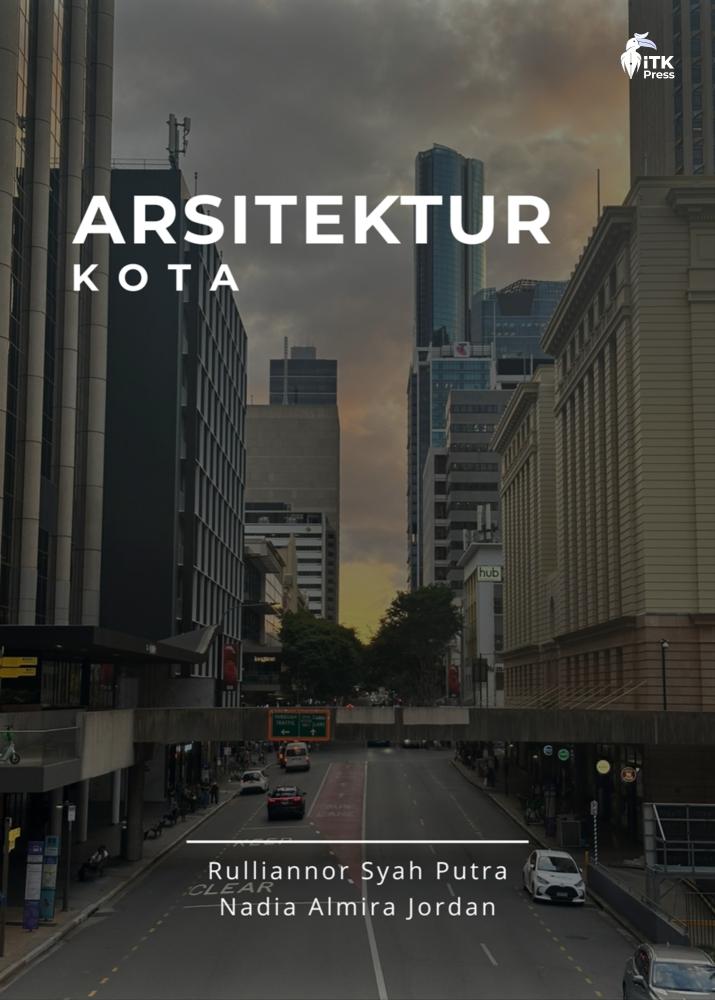
ARSITEKTUR KOTA
Keywords:
Arsitektur Kota, Climate Sensitive Urban Design (CSUD), Desain Kota, Keberlanjutan, Ruang PublikSynopsis
Di tengah pesatnya perkembangan kota dan meningkatnya tekanan terhadap lingkungan, perancangan kawasan perkotaan dituntut untuk tidak hanya fungsional, tetapi juga berkelanjutan dan berorientasi pada kualitas hidup masyarakat. Arsitektur Kota hadir sebagai panduan komprehensif yang mengulas konsep, prinsip, serta pendekatan dalam merancang kota yang adaptif terhadap tantangan masa kini. Buku ini membahas secara mendalam mengenai desain kota, penerapan Climate Sensitive Urban Design (CSUD), serta keterkaitannya dengan aspek sosial, ekonomi, dan lingkungan. Berbagai isu strategis seperti aksesibilitas, konektivitas, hingga penguatan ruang publik dikaji untuk menghasilkan lingkungan perkotaan yang inklusif, nyaman, dan berdaya saing.
Order now
References
Akbari, H., et al. (2016). Measuring and Modeling the Urban Heat Island Effect and Its Impact on Building Energy Consumption: A Review. Energy and Buildings, 133, 1021-1049. (Meskipun beberapa referensi Akbari lebih tua, ia banyak menulis dan terus relevan dalam dekade terakhir).
Allegrini, J., Dorer, V., & Carmeliet, J. (2015). Influence of urban morphology on the microclimate of a street canyon. Journal of Wind Engineering and Industrial Aerodynamics, 144, 21-36.
Attia, S., et al. (2013). Urban heat island mitigation in hot arid climates: A review of passive cooling strategies in buildings. Renewable and Sustainable Energy Reviews, 26, 40-54. (Meskipun lebih dari 10 tahun, relevansinya masih kuat untuk konteks strategi pasif).
Blocken, B. (2015). Computational Fluid Dynamics for urban physics: Recent achievements and future challenges. Journal of Wind Engineering and Industrial Aerodynamics, 129, 216-235.
Chow, W. T., et al. (2017). Understanding and mitigating urban heat island effect using remote sensing techniques: A review. Science of the Total Environment, 607, 1063-1077.
Ding, L., et al. (2016). Integrated design optimization of building envelope considering passive strategies for hot and humid climates. Applied Energy, 178, 629-644.
Fletcher, T. D., et al. (2015). SUDS, LID, BMPs, WSUD and more: The evolution and application of terminology surrounding urban drainage. Urban Water Journal, 12(7), 525–542.
Friedmann, J. (2011). Insurgencies: Essays in Planning Theory. Routledge.
Gehl, J. (2011). Life Between Buildings: Using Public Space. Washington DC: Island Press.
IEA. (2022). Transport: Tracking Report. International Energy Agency.
IEA. (2023). Energy Efficiency 2023: Analysis and Outlooks to 2030
IPCC. (2022). Climate Change 2022: Mitigation of Climate Change. Intergovernmental Panel on Climate Change.
Kabisch, N., et al. (2017). Nature-based solutions to climate change adaptation in urban areas: Linkages between science, policy and practice. Springer.
Kementerian PUPR. (2018). Peraturan Menteri PUPR No. 14/PRT/M/2017 tentang Persyaratan Kemudahan Bangunan Gedung. Jakarta.
Kwok, C. F., Chen, S., & Li, D. H. W. (2020). A review of recent studies on natural ventilation performance in urban residential buildings. Building and Environment, 185, 107297.
Lee, J., & Anderson, C. (2013). The restoration of the Cheonggyecheon stream in Seoul, South Korea. Ecological Restoration, 31(1), 22–28.
Lynch, K. (1960). The Image of the City. Cambridge: MIT Press.
Mace, R. (1998). Universal Design in Housing. North Carolina State University.
Middel, A., Häb, K., & Krayenhoff, E. S. (2014). Urban form and microclimate: a review of research methods and recent advances. Landscape and Urban Planning, 131, 10-23.
REN21. (2023). Renewables 2023 Global Status Report.
Ren, C., et al. (2018). Spatio-temporal analysis of urban heat island effect in a high-density city: A case study of Hong Kong. Building and Environment, 136, 179-195.
Rizwan, A. M., et al. (2019). Influence of urban morphology on urban microclimate in hot and humid climates: A review. Renewable and Sustainable Energy Reviews, 106, 27-41.
Santamouris, M. (2014). Cooling the cities–A review of reflective and green roof mitigation technologies to fight heat island and improve comfort in urban environments. Solar Energy, 103, 682-698.
Santamouris, M., et al. (2018). Cooling the cities – A review of reflective and green roof mitigation technologies to fight heat island and improve comfort in urban environments. Solar Energy, 103, 682–703.
Santamouris, M., et al. (2018). Recent progress in urban heat island mitigation technologies. Renewable and Sustainable Energy Reviews, 91, 1007-1025.
Setiawan, M. A., et al. (2021). Review of urban heat island effect in tropical cities: Strategies for mitigation and adaptation. IOP Conference Series: Earth and Environmental Science, 856(1), 012015.
Sharifi, A. (2016). From Garden City to Eco-urbanism: The Quest for Sustainable Neighborhood Development. Sustainable Cities and Society, 20, 1–16.
Sharifi, A. (2016). From Garden City to Eco-urbanism: The quest for sustainable urban form. Journal of Cleaner Production, 132, 10–20.
Sharifi, A. (2016). From green growth to smart growth: A new paradigm for sustainable urban development. Cities, 50, 109-118.
Shashua-Bar, L., Pearlmutter, D., & Erell, E. (2011). The cooling effect of urban green areas on the building envelope: a parametric simulation study. Energy and Buildings, 43(11), 3040-3051. (Meski sedikit lebih dari 10 tahun, ini klasik dan sangat relevan).
Shi, L., et al. (2021). Urban climate resilience: A systematic review of policy and planning approaches. Journal of Cleaner Production, 292, 125956.
Steinfeld, E., & Maisel, J. (2012). Universal Design: Creating Inclusive Environments. Hoboken: Wiley.
Sun, R., Chen, A., Chen, L., & Lü, Y. (2017). Cooling effects of urban green vegetation in Beijing. Urban Forestry & Urban Greening, 20, 180–187.
Sun, Y., et al. (2017). Mitigating urban heat island effect through vegetation: A review. Urban Forestry & Urban Greening, 28, 149-162.
Susca, T., Gaffin, S., & Dell'Osso, L. (2011). A model to assess the environmental performance of green roofs. Ecological Modelling, 222(20-22), 3726-3738. (Sama seperti Oke, relevansinya masih kuat).
UN-Habitat. (2013). Streets as Public Spaces and Drivers of Urban Prosperity. Nairobi: United Nations.
World Health Organization (WHO). (2022). Urban Green Space Interventions and Health: A Review of Impacts and Effectiveness. WHO Regional Office for Europe.
Yang, P., et al. (2019). Public perception and awareness of green buildings: A case study in China. Energy and Buildings, 192, 172-182.
Yeang, K., & Woolley, T. (2018). EcoDesign: A Manual for Ecological Design. Routledge. (Edisi terbaru dari buku Yeang).
Yeang, K., & Woolley, B. (2018). Sustainable Urban Design: An Environmental Approach. Routledge.
Zakaria, M., & Kubota, T. (2019). Challenges and opportunities of sustainable building development in developing countries: A review of Malaysian experience. Energy and Buildings, 182, 33-45.
Zakaria, R., & Kubota, T. (2019). Circular Economy and Urban Agriculture: A New Synergy for Sustainable Cities. Journal of Cleaner Production, 230, 1231–1240.
Zhang, Y., et al. (2020). Passive design strategies in buildings: A review and development of strategies and design tools. Renewable and Sustainable Energy Reviews, 132, 110112.
Zölch, T., et al. (2016). The urban tree canopy as a climate change adaptation measure: An assessment for Stuttgart, Germany. Landscape and Urban Planning, 148, 114-129.
Published
License

This work is licensed under a Creative Commons Attribution-NonCommercial-ShareAlike 4.0 International License.