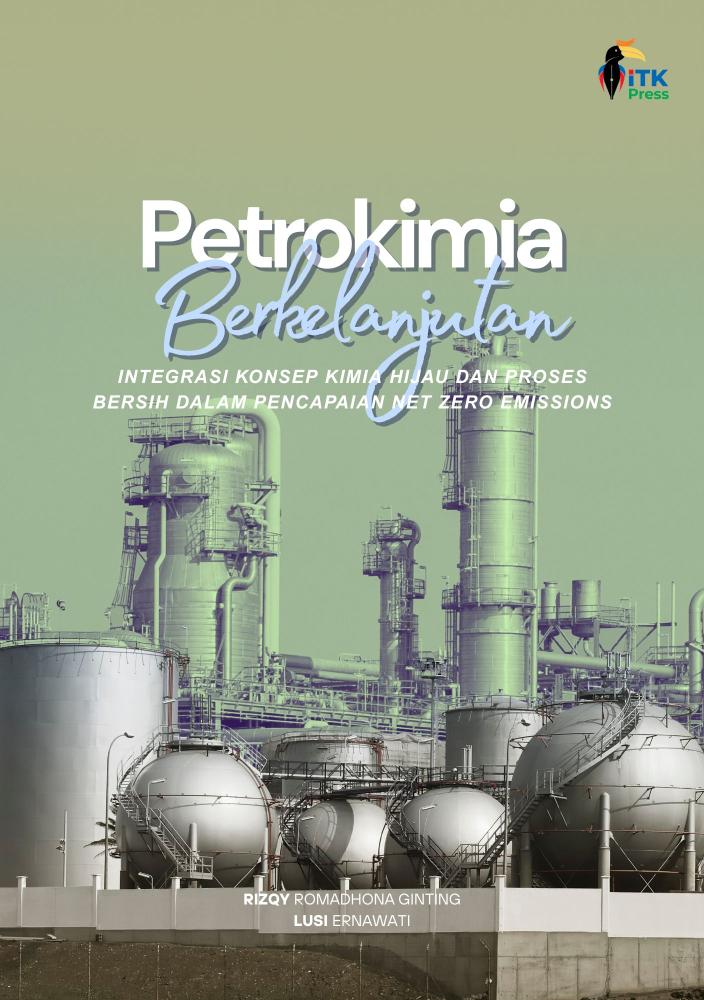
PETROKIMIA BERKELANJUTAN: INTEGRASI KONSEP KIMIA HIJAU DAN PROSES BERSIH DALAM PENCAPAIAN NET ZERO EMISSIONS
Keywords:
Dekarbonisasi, Ekonomi Sirkular, Kimia Hijau, Net Zero Emissions, Petrokimia BerkelanjutanSynopsis
Di tengah tantangan perubahan iklim dan tuntutan global menuju net zero emissions, industri petrokimia dituntut untuk bertransformasi secara fundamental. Buku Petrokimia Berkelanjutan: Integrasi Konsep Kimia Hijau dan Proses Bersih dalam Pencapaian Net Zero Emissions hadir sebagai panduan komprehensif yang menjembatani kebutuhan industri, akademisi, dan pembuat kebijakan dalam membangun sistem produksi yang lebih ramah lingkungan dan efisien. Buku ini mengupas secara mendalam penerapan prinsip-prinsip kimia hijau, efisiensi energi, minimisasi limbah, pemanfaatan bahan baku terbarukan, hingga strategi dekarbonisasi dalam rantai proses petrokimia. Tidak hanya membahas konsep teoretis, buku ini juga menyajikan pendekatan praktis, studi kasus industri, inovasi teknologi proses bersih, serta integrasi ekonomi sirkular dalam sistem produksi modern. Dengan pendekatan interdisipliner yang sistematis dan aplikatif, buku ini membantu pembaca memahami bagaimana transformasi teknologi, optimalisasi proses, dan inovasi material dapat secara nyata berkontribusi pada pengurangan emisi gas rumah kaca tanpa mengorbankan produktivitas dan daya saing industri. Buku ini sangat relevan bagi mahasiswa teknik kimia dan teknik lingkungan, praktisi industri petrokimia, peneliti, serta pengambil kebijakan yang berkomitmen mendorong transisi menuju industri rendah karbon. Sebuah referensi penting untuk masa depan industri petrokimia yang lebih bersih, berkelanjutan, dan selaras dengan agenda global menuju Net Zero Emissions.
Order now
References
Abdussalam-Mohammed, W., Ali, A. Q., & Errayes, A. O. (2020). Green Chemistry: Principles, Applications, and Disadvantages. Chemical Methodologies, 4(4), 408–423. https://doi.org/10.33945/SAMI/CHEMM.2020.4.4
Adambekova, A., Kozhagulov, S., Quadrado, J. C., Salnikov, V., Polyakova, S., Tazhibayeva, T., & Ulman, A. (2025). Reducing Atmospheric Pollution as the Basis of a Regional Circular Economy: Evidence from Kazakhstan. Sustainability, 17(5), 2249. https://doi.org/10.3390/su17052249
Ahmed, H. S., Yahya, Z., Ali khan, W., & Faraz, A. (2024). Sustainable pathways to ammonia: a comprehensive review of green production approaches. Clean Energy, 8(2), 60–72. https://doi.org/10.1093/ce/zkae002
Alkathiri, R., Alshamrani, A., Wazeer, I., Boumaza, M., & Hadj-Kali, M. K. (2022). Optimization of the Oxidative Coupling of Methane Process for Ethylene Production. Processes, 10(6), 1085. https://doi.org/10.3390/pr10061085
Alsayegh, S., Johnson, J. R., Ohs, B., & Wessling, M. (2019). Methanol production via direct carbon dioxide hydrogenation using hydrogen from photocatalytic water splitting: Process development and techno-economic analysis. Journal of Cleaner Production, 208, 1446–1458. https://doi.org/10.1016/j.jclepro.2018.10.132
Amoneit, M., Weckowska, D., Spahr, S., Wagner, O., Adeli, M., Mai, I., & Haag, R. (2024). Green chemistry and responsible research and innovation: Moving beyond the 12 principles. Journal of Cleaner Production, 484, 144011. https://doi.org/10.1016/j.jclepro.2024.144011
Anastas, P., & Eghbali, N. (2010). Green Chemistry: Principles and Practice. Chem. Soc. Rev., 39(1), 301–312. https://doi.org/10.1039/B918763B
Baral, S., & Šebo, J. (2024). Techno-economic assessment of green hydrogen production integrated with hybrid and organic Rankine cycle (ORC) systems. Heliyon, 10(4), e25742. https://doi.org/10.1016/j.heliyon.2024.e25742
Boilley, J.-H., Behloul, C., Shahrel, H. Bin, Gürbüz, E., Jeandaux, C., Khamphasith, M., Bellahcene, R., Berrady, A., Gallucci, F., & Olivier, P. (2025). Techno-economic and life cycle assessment of e-kerosene production from captured carbon dioxide and green hydrogen. Energy Conversion and Management, 345, 120354. https://doi.org/10.1016/j.enconman.2025.120354
Chen, G., Li, S., Jiao, F., & Yuan, Q. (2007). Catalytic dehydration of bioethanol to ethylene over TiO2/γ-Al2O3 catalysts in microchannel reactors. Catalysis Today, 125(1–2), 111–119. https://doi.org/10.1016/j.cattod.2007.01.071
Chen, Y., Kuo, M. J., Lobo, R., & Ierapetritou, M. (2024). Ethylene production: process design, techno-economic and life-cycle assessments. Green Chemistry, 26(5), 2903–2911. https://doi.org/10.1039/D3GC03858K
Chorowski, M., Lepszy, M., Machaj, K., Malecha, Z., Porwisiak, D., Porwisiak, P., Rogala, Z., & Stanclik, M. (2023). Challenges of Application of Green Ammonia as Fuel in Onshore Transportation. Energies, 16(13), 4898. https://doi.org/10.3390/en16134898
Ganesh, K. N., Zhang, D., Miller, S. J., Rossen, K., Chirik, P. J., Kozlowski, M. C., Zimmerman, J. B., Brooks, B. W., Savage, P. E., Allen, D. T., & Voutchkova-Kostal, A. M. (2021). Green Chemistry: A Framework for a Sustainable Future. ACS Omega, 6(25), 16254–16258. https://doi.org/10.1021/acsomega.1c03011
Guchhait, S. K., Khatana, S., Saini, R. K., Das, A. K., & Shaswattam. (2025). Recent advances in mechanistic pathways and catalyst architecture for the synthesis of sustainable aviation fuel from CO2. Sustainable Chemistry for Climate Action, 7, 100154. https://doi.org/10.1016/j.scca.2025.100154
Hu, R., Li, X., Sui, Z., Ye, G., & Zhou, X. (2019). Process simulation and optimization of propane dehydrogenation combined with selective hydrogen combustion. Chemical Engineering and Processing - Process Intensification, 143, 107608. https://doi.org/10.1016/j.cep.2019.107608
Jacquemin, L., Pontalier, P.-Y., & Sablayrolles, C. (2012). Life cycle assessment (LCA) applied to the process industry: a review. The International Journal of Life Cycle Assessment, 17(8), 1028–1041. https://doi.org/10.1007/s11367-012-0432-9
Lahuri, H. M., Lahijani, P., & Mohamed, A. R. (2025). A comprehensive evaluation of high-sulfur petroleum coke in CO2 gasification to produce low-carbon syngas. Chemical Engineering Journal Advances, 24, 100842. https://doi.org/10.1016/j.ceja.2025.100842
Lapa, H. M., & Martins, L. M. D. R. S. (2023). p-Xylene Oxidation to Terephthalic Acid: New Trends. Molecules, 28(4), 1922. https://doi.org/10.3390/molecules28041922
Liu, J., Yang, Y., Wei, S., Shen, W., Rakovitis, N., & Li, J. (2018). Intensified p -Xylene Production Process through Toluene and Methanol Alkylation. Industrial & Engineering Chemistry Research, 57(38), 12829–12841. https://doi.org/10.1021/acs.iecr.8b00681
Ma, S., Ding, W., Liu, Y., Zhang, Y., Ren, S., Kong, X., & Leng, J. (2024). Industry 4.0 and cleaner production: A comprehensive review of sustainable and intelligent manufacturing for energy-intensive manufacturing industries. Journal of Cleaner Production, 467, 142879. https://doi.org/10.1016/j.jclepro.2024.142879
Nami, H., Hendriksen, P. V., & Frandsen, H. L. (2024a). Green ammonia production using current and emerging electrolysis technologies. Renewable and Sustainable Energy Reviews, 199, 114517. https://doi.org/10.1016/j.rser.2024.114517
Nami, H., Hendriksen, P. V., & Frandsen, H. L. (2024b). Green ammonia production using current and emerging electrolysis technologies. Renewable and Sustainable Energy Reviews, 199, 114517. https://doi.org/10.1016/j.rser.2024.114517
Nowicki, D. A., Agnew, G. D., & Irvine, J. T. S. (2023). Green ammonia production via the integration of a solid oxide electrolyser and a Haber-Bosch loop with a series of solid electrolyte oxygen pumps. Energy Conversion and Management, 280, 116816. https://doi.org/10.1016/j.enconman.2023.116816
Pan, D., Song, X., Yang, X., Gao, L., Wei, R., Zhang, J., & Xiao, G. (2018). Efficient and selective conversion of methanol to para-xylene over stable H[Zn,Al]ZSM-5/SiO2 composite catalyst. Applied Catalysis A: General, 557, 15–24. https://doi.org/10.1016/j.apcata.2018.03.006
Preethi, M., G., Kumar, G., Karthikeyan, O. P., Varjani, S., & J., R. B. (2021). Lignocellulosic biomass as an optimistic feedstock for the production of biofuels as valuable energy source: Techno-economic analysis, Environmental Impact Analysis, Breakthrough and Perspectives. Environmental Technology & Innovation, 24, 102080. https://doi.org/10.1016/j.eti.2021.102080
Sánchez-Luján, J., Molina-García, Á., & López-Cascales, J. J. (2024). Optimal integration modeling of Co – Electrolysis in a power-to-liquid industrial process. International Journal of Hydrogen Energy, 52, 1202–1219. https://doi.org/10.1016/j.ijhydene.2023.07.012
Soni, K., Lanjekar, P. R., & Panwar, N. L. (2025). Biomass-based green ammonia: Pathways, technologies, and sustainability for a carbon-neutral future. Unconventional Resources, 8, 100241. https://doi.org/10.1016/j.uncres.2025.100241
Spatolisano, E., & Figini, D. (2025). Absorption-enhanced Haber-Bosch for small-scale green NH3 production. A feasibility study. Energy Conversion and Management, 337, 119904. https://doi.org/10.1016/j.enconman.2025.119904
Stoots, C. M., O’Brien, J. E., Herring, J. S., & Hartvigsen, J. J. (2009). Syngas Production via High-Temperature Coelectrolysis of Steam and Carbon Dioxide. Journal of Fuel Cell Science and Technology, 6(1). https://doi.org/10.1115/1.2971061
Sun, J., Yu, H., Yin, Z., Jiang, L., Wang, L., Hu, S., & Zhou, R. (2023). Process Simulation and Optimization of Fluid Catalytic Cracking Unit’s Rich Gas Compression System and Absorption Stabilization System. Processes, 11(7), 2140. https://doi.org/10.3390/pr11072140
Syah, R., Davarpanah, A., Elveny, M., Ghasemi, A., & Ramdan, D. (2021). The Economic Evaluation of Methanol and Propylene Production from Natural Gas at Petrochemical Industries in Iran. Sustainability, 13(17), 9990. https://doi.org/10.3390/su13179990
Tavares Borges, P., Silva Lora, E. E., Venturini, O. J., Errera, M. R., Yepes Maya, D. M., Makarfi Isa, Y., Kozlov, A., & Zhang, S. (2024). A Comprehensive Technical, Environmental, Economic, and Bibliometric Assessment of Hydrogen Production Through Biomass Gasification, Including Global and Brazilian Potentials. Sustainability, 16(21), 9213. https://doi.org/10.3390/su16219213
Ueckerdt, F., Bauer, C., Dirnaichner, A., Everall, J., Sacchi, R., & Luderer, G. (2021). Potential and risks of hydrogen-based e-fuels in climate change mitigation. Nature Climate Change, 11(5), 384–393. https://doi.org/10.1038/s41558-021-01032-7
Wang, D., Zhang, J., Dong, P., Li, G., Fan, X., & Yang, Y. (2022). Novel Short Process for p -Xylene Production Based on the Selectivity Intensification of Toluene Methylation with Methanol. ACS Omega, 7(1), 1211–1222. https://doi.org/10.1021/acsomega.1c05817
Yang, H., Zhang, C., Gao, P., Wang, H., Li, X., Zhong, L., Wei, W., & Sun, Y. (2017). A review of the catalytic hydrogenation of carbon dioxide into value-added hydrocarbons. Catalysis Science & Technology, 7(20), 4580–4598. https://doi.org/10.1039/C7CY01403A
Yu, G., & Jia, Y. (2022). Microstructure and Mechanical Properties of Fly Ash-Based Geopolymer Cementitious Composites. Minerals, 12(7), 853. https://doi.org/10.3390/min12070853
Zhang, Y., Li, A., Fei, Y., Zhang, C., Zhu, L., & Huang, Z. (2024). Techno-economic assessment of electro-synthetic fuel based on solid oxide electrolysis cell coupled with Fischer–Tropsch strategy. Journal of CO2 Utilization, 86, 102905. https://doi.org/10.1016/j.jcou.2024.102905
Zhu, J., Feng, L., Yu, C., & Wu, L. (2025). Renewable methanol production from biomass gasification coupled with green hydrogen: Process design and economic assessment. International Journal of Hydrogen Energy, 191, 151693. https://doi.org/10.1016/j.ijhydene.2025.151693
Published
License

This work is licensed under a Creative Commons Attribution-NonCommercial-ShareAlike 4.0 International License.