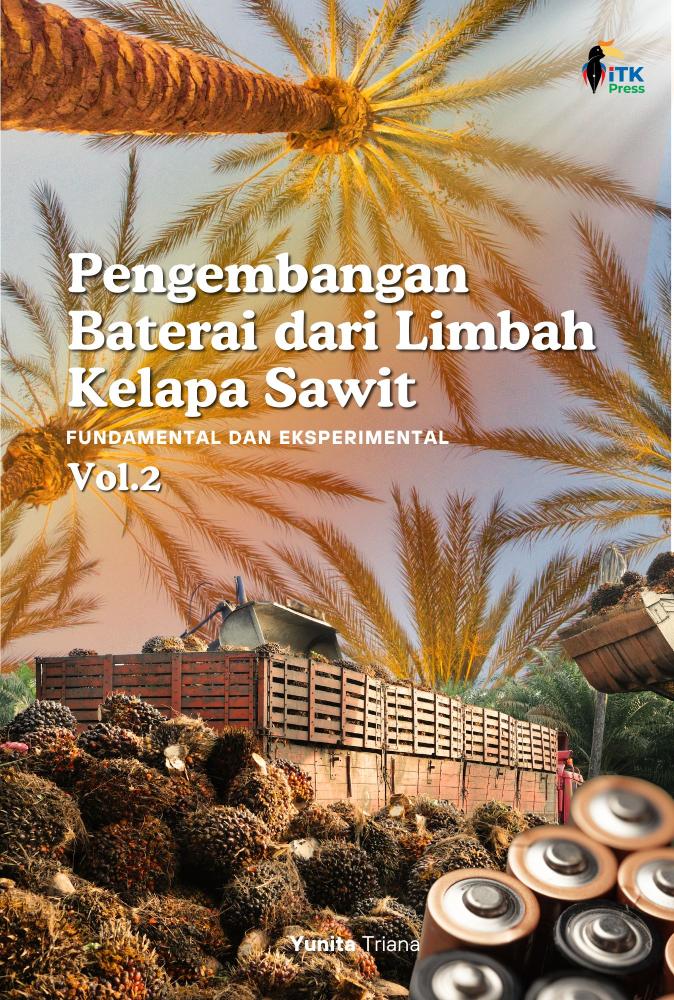
PENGEMBANGAN BATERAI DARI LIMBAH KELAPA SAWIT: FUNDAMENTAL DAN EKSPERIMENTAL VOL.2
Keywords:
Baterai biomassa, Karakterisasi material, Limbah kelapa sawit, Penyimpanan energi berkelanjutan, Sintesis dan optimasi materialSynopsis
Melanjutkan fondasi konseptual yang telah dibangun pada Volume 1, buku Pengembangan Baterai dari Limbah Kelapa Sawit: Fundamental dan Eksperimental Vol. 2 hadir sebagai eksplorasi lanjutan yang lebih mendalam, kritis, dan aplikatif terhadap pemanfaatan limbah kelapa sawit dalam teknologi baterai. Volume ini menitikberatkan pada pengembangan material, karakterisasi lanjutan, serta pendekatan eksperimental yang lebih kompleks untuk meningkatkan kinerja dan keandalan baterai berbasis biomassa. Pembahasan mencakup optimasi proses sintesis, analisis struktur dan sifat elektrokimia, hingga evaluasi performa baterai dalam berbagai skenario pengujian, sehingga memberikan gambaran yang lebih komprehensif mengenai potensi implementasi teknologi ini. Dengan memadukan hasil riset terkini, metodologi eksperimental yang terukur, serta pembahasan berbasis data, buku ini memperkuat jembatan antara penelitian dasar dan pengembangan teknologi terapan. Ditujukan bagi akademisi, peneliti, mahasiswa pascasarjana, serta praktisi industri energi dan material, Volume 2 menjadi referensi penting dalam mendorong inovasi baterai ramah lingkungan yang berdaya saing. Buku ini menegaskan bahwa limbah kelapa sawit bukan sekadar sisa produksi, melainkan sumber daya strategis untuk membangun masa depan teknologi penyimpanan energi yang berkelanjutan, mandiri, dan berbasis potensi lokal.
Order now
References
Abdulkadir, B. A., Dennis, J. O., Fadhlullah Bin Abd. Shukur, M., Elsayed Nasef, M. M., & Usman, F. (2020a). Preparation and characterization of gel polymer electrolyte based on PVA-K2CO3. Polymer-Plastics Technology and Materials, 59(15), 1679–1697. https://doi.org/10.1080/25740881.2020.1765380
Abdulkadir, B. A., Dennis, J. O., Fadhlullah Bin Abd. Shukur, M., Elsayed Nasef, M. M., & Usman, F. (2020b). Preparation and characterization of gel polymer electrolyte based on PVA-K2CO3. Polymer-Plastics Technology and Materials, 59(15), 1679–1697. https://doi.org/10.1080/25740881.2020.1765380
Abdulkadir, B. A., Dennis, J. O., Shukur, M. F. B. A., Nasef, M. M. E., & Usman, F. (2021). Study on Dielectric Properties of Gel Polymer Electrolyte Based on PVA-K2CO3 Composites. International Journal of Electrochemical Science, 16(1), 1–15. https://doi.org/10.20964/2021.01.34
Abimanyu, F., Rosi, M., & Abrar. (2021). Fabrikasi Elektroda Karbon Aktif Superkapasitor dengan Menggunakan Metode Hotpress. E-Proceeding of Engineering, 8(5), 5685.
Agmerio, M., & Junaidi, R. (2020). Prototype of Activated Carbon-Based Battery from Betung Bamboo: Reviewing the Effect of Activated Carbon and Electrolyte on Improving Battery Performance. Jurnal Kinetika, 11(01), 55–60. https://jurnal.polsri.ac.id/index.php/kimia/index55
Aisha Noer, A., & Malik Jurusan Fisika, U. (2014). Pembuatan Karbon Aktif dari Pelepah Kelapa Sawit Menggunakan Aktivator H 2 O Sebagai Adsorben. In JOM FMIPA Volume (Vol. 1, Issue OKTOBER).
Akbar, M. I., Zahirah, N., Utomo, Y. M. P., Risnawati, R., Astuti, W., Rohimsyah, F. M., & Triana, Y. (2024). Application of palm oil frond activated carbon for biobattery electrodes. Energy Storage, 6(1), e547. https://doi.org/https://doi.org/10.1002/est2.547
Alfi, R., Lubis, F., Nasution, H. I., & Zubir, M. (2020). Production of Activated Carbon from Natural Sources for Water Purification.
Anastasaki, E., Kanakis, C., Pappas, C., Maggi, L., del Campo, C. P., Carmona, M., Alonso, G. L., & Polissiou, M. G. (2010). Differentiation of saffron from four countries by mid-infrared spectroscopy and multivariate analysis. European Food Research and Technology, 230(4), 571–577. https://doi.org/10.1007/s00217-009-1197-7
Andalia, W., & Pratiwi, I. (2018). Kinerja Katalis Naoh dan KOH ditinjau dari Kualitas Produk Biodiesel yang dihasilkan dari Minyak Goreng Bekas. 7.
Apriani, R., Diah Faryuni, I., Wahyuni, D., Kunci, K., Aktif, K., Durian, K., Hidroksida, K., & Fe, A. (2013). Pengaruh Konsentrasi Aktivator Kalium Hidroksida (KOH) terhadap Kualitas Karbon Aktif Kulit Durian sebagai Adsorben Logam Fe pada Air Gambut. I(2), 82–86.
Ayinla, R. T., Dennis, J. O., Zaid, H. M., Sanusi, Y. K., Usman, F., & Adebayo, L. L. (2019). A review of technical advances of recent palm bio-waste conversion to activated carbon for energy storage. In Journal of Cleaner Production (Vol. 229, pp. 1427–1442). Elsevier Ltd. https://doi.org/10.1016/j.jclepro.2019.04.116
Baig, M. M., & Gul, I. H. (2021). Conversion of wheat husk to high surface area activated carbon for energy storage in high-performance supercapacitors. Biomass and Bioenergy, 144. https://doi.org/10.1016/j.biombioe.2020.105909
Berl, E., & Schmidt, A. (1928). Über das Verhalten der Cellulose bei der Druckerhitzung mit Wasser. Justus Liebigs Annalen Der Chemie, 461(1), 192–220. https://doi.org/10.1002/jlac.19284610110
Borghei, S. A., Zare, M. H., Ahmadi, M., Sadeghi, M. H., Marjani, A., Shirazian, S., & Ghadiri, M. (2021). Synthesis of multi-application activated carbon from oak seeds by KOH activation for methylene blue adsorption and electrochemical supercapacitor electrode. Arabian Journal of Chemistry, 14(2). https://doi.org/10.1016/j.arabjc.2020.102958
Broseghini, M., Gelisio, L., D’Incau, M., Azanza Ricardo, C. L., Pugno, N. M., & Scardi, P. (2016). Modeling of the planetary ball-milling process: The case study of ceramic powders. Journal of the European Ceramic Society, 36(9), 2205–2212. https://doi.org/10.1016/J.JEURCERAMSOC.2015.09.032
Budiman, I., Hermawan, D., & Febrianto, F. (n.d.). Optimasi Aktivasi Arang Aktif dari Arang Hidro Tempurung Buah Kelapa Sawit Menggunakan Metodologi Permukaan Respon (Optimization of Activated Carbon from Oil Palm Shell Hydrochar U. https://www.researchgate.net/publication/335879119
Cazetta, A. L., Vargas, A. M. M., Nogami, E. M., Kunita, M. H., Guilherme, M. R., Martins, A. C., Silva, T. L., Moraes, J. C. G., & Almeida, V. C. (2011a). NaOH-activated carbon of high surface area produced from coconut shell: Kinetics and equilibrium studies from the methylene blue adsorption. Chemical Engineering Journal, 174(1), 117–125. https://doi.org/10.1016/j.cej.2011.08.058
Cazetta, A. L., Vargas, A. M. M., Nogami, E. M., Kunita, M. H., Guilherme, M. R., Martins, A. C., Silva, T. L., Moraes, J. C. G., & Almeida, V. C. (2011b). NaOH-activated carbon of high surface area produced from coconut shell: Kinetics and equilibrium studies from the methylene blue adsorption. Chemical Engineering Journal, 174(1), 117–125. https://doi.org/10.1016/j.cej.2011.08.058
Chang, S. H. (2014a). An overview of empty fruit bunch from oil palm as feedstock for bio-oil production. In Biomass and Bioenergy (Vol. 62, pp. 174–181). https://doi.org/10.1016/j.biombioe.2014.01.002
Chang, S. H. (2014b). An overview of empty fruit bunch from oil palm as feedstock for bio-oil production. Biomass and Bioenergy, 62, 174–181. https://doi.org/10.1016/J.BIOMBIOE.2014.01.002
Collard, F. X., & Blin, J. (2014). A review on pyrolysis of biomass constituents: Mechanisms and composition of the products obtained from the conversion of cellulose, hemicelluloses and lignin. In Renewable and Sustainable Energy Reviews (Vol. 38, pp. 594–608). Elsevier Ltd. https://doi.org/10.1016/j.rser.2014.06.013
Dennis, J. O., Shukur, M. F., Aldaghri, O. A., & Ibnaouf, K. H. (2023). A Review of Current Trends on Polyvinyl Alcohol (PVA)-Based Solid Polymer Electrolytes. Molecules, 28(4), 1781.
Dewa, I., Subamia, P., Widiasih, N., Ayu, G., Wahyuni, N. S., Lilik, P., Kristiyanti, P., Biologi, J., Kelautan, P., Matematika, F., Ilmu, D., & Alam, P. (2023). Optimasi Kinerja Alat Fourier Transform Infrared (FTIR) Melaui Studi Perbandingan Komposisi dan Ketebalan Sampel-KBr. Jurnal Pengelolaan Laboratorium Pendidikan, 5(2).
Dornbusch, D. A., Hilton, R., Gordon, M. J., & Suppes, G. J. (2013). Effects of carbon surface area on performance of lithium sulfur battery cathodes. Journal of Industrial and Engineering Chemistry, 19(6), 1968–1972. https://doi.org/10.1016/j.jiec.2013.03.005
Dwika Hardi, A., Joni, R., Aziz, H., Kimia Fisika, L., Kimia, J., & Artikel, H. (2020a). Pembuatan Karbon Aktif dari Tandan Kosong Kelapa Sawit sebagai Elektroda Superkapasitor. Jurnal Fisika Unand (JFU), 9(4), 479–486. https://doi.org/10.25077/jfu.9.4.479-486-.2020
Dwika Hardi, A., Joni, R., Aziz, H., Kimia Fisika, L., Kimia, J., & Artikel, H. (2020b). Pembuatan Karbon Aktif dari Tandan Kosong Kelapa Sawit sebagai Elektroda Superkapasitor. Jurnal Fisika Unand (JFU), 9(4), 479–486. https://doi.org/10.25077/jfu.9.4.479-486-.2020
Efiyanti, L., Wati, S. A., Maslahat, M., & Kehutanan, J. I. (2020). Pembuatan dan Analisis Karbon Aktif dari Cangkang Buah Karet dengan Proses Kimia dan Fisika Manufacture and Analysis of Activated Carbon from Rubber Fruit Shell with Chemical and Physical Processing. In Jurnal Ilmu Kehutanan (Vol. 14). https://jurnal.ugm.ac.id/jikfkt
Esterlita, M. O., & Herlina, N. (2015). Pengaruh Penambahan Aktivator ZnCl₂, KOH, dan H₃PO₄ dalam Pembuatan Karbon Aktif dari Pelepah Aren (Arenga pinnata). In Jurnal Teknik Kimia USU (Vol. 4, Issue 1).
Faisal, & Usman, P. (2018). Studi Konsentrasi Kalium Hidroksida (KOH) Terhadap Kualitas Karbon Aktif Tempurung Kluwak. Jom Faperta, 2(8).
Fajrianti, H., Oktiawan, W., & Wardhana, I. W. (2016). Pengaruh Waktu Perendaman dalam Aktivator NaOH dan Debit Aliran Terhadap Penurunan Krom Total (Cr) Dan Seng (Zn) pada Limbah Cair Industri Elektroplating Dengan Menggunakan Arang Aktif. Jurnal Teknik Lingkungan, 5(1). http://ejournal-s1.undip.ac.id/index.php/tlingkungan
Farma, R., Melinda, V., Taer, E., & Hamzah Ringkasan, Y. (n.d.). Cyclic V oltammetry Sel Superkapasitor Dengan Variasi Konsentrasi Aktivator Kalium Hidroksida.
Farma, R., & Wahyuni, F. (2019). Physical Properties Analysis of Activated Carbon from Oil Palm Empty Fruit Bunch Fiber on Methylene Blue Adsorption. Journal of Technomaterial Physics *Corresponding Author at: Bina Widya Km, 1(1), 28293.
Fletcher, A. J. (2008). Porosity and sorption behaviour. Adsorption.
Funke, A., & Ziegler, F. (2010). Hydrothermal carbonization of biomass: A summary and discussion of chemical mechanisms for process engineering. Biofuels, Bioproducts and Biorefining, 4(2), 160–177. https://doi.org/10.1002/bbb.198
Giorgi, V., Botto, E., Fontana, C., Mea, L. Della, Vaz, S., Menéndez, P., & Rodríguez, P. (2022). Enzymatic Production of Lauroyl and Stearoyl Monoesters of D-Xylose, L-Arabinose, and D-Glucose as Potential Lignocellulosic-Derived Products, and Their Evaluation as Antimicrobial Agents. Catalysts, 12(6). https://doi.org/10.3390/catal12060610
González-García, P. (2018). Activated carbon from lignocellulosics precursors: A review of the synthesis methods, characterization techniques and applications. Renewable and Sustainable Energy Reviews, 82, 1393–1414. https://doi.org/10.1016/J.RSER.2017.04.117
Han, R. R., Zhu, H. Y., Li, M. P., Yang, W. T., Lu, C., Zhang, Y. S., Zhang, B. M., Liang, X. R., & Liu, M. C. (2020a). Efficient Preparation of Spongy-Like Porous-Activated Carbon from Waste Millfeed towards High Performance Supercapacitors. Nano, 15(8). https://doi.org/10.1142/S1793292020501064
Han, R. R., Zhu, H. Y., Li, M. P., Yang, W. T., Lu, C., Zhang, Y. S., Zhang, B. M., Liang, X. R., & Liu, M. C. (2020b). Efficient Preparation of Spongy-Like Porous-Activated Carbon from Waste Millfeed towards High Performance Supercapacitors. Nano, 15(8). https://doi.org/10.1142/S1793292020501064
Hartanto, S., & Ratnawati. (2010a). Pembuatan Karbon Aktif dari Tempurung Kelapa Sawit dengan Metode Aktivasi Kimia. Jurnal Sains Materi Indonesia, 12(1).
Hartanto, S., & Ratnawati. (2010b). Pembuatan Karbon Aktif dari Tempurung Kelapa Sawit dengan Metode Aktivasi Kimia (Singgih Hartanto).
Hassan, A. F., & Youssef, A. M. (2014a). Preparation and characterization of microporous NaOH-activated carbons from hydrofluoric acid leached rice husk and its application for lead(II) adsorption. Carbon Letters, 15(1), 57–66. https://doi.org/10.5714/cl.2014.15.1.057
Hassan, A. F., & Youssef, A. M. (2014b). Preparation and characterization of microporous NaOH-activated carbons from hydrofluoric acid leached rice husk and its application for lead(II) adsorption. Carbon Letters, 15(1), 57–66. https://doi.org/10.5714/cl.2014.15.1.057
Hidayat, A., & Sutrisno, B. (2016). Comparison on pore development of activated carbon produced by chemical and physical activation from palm empty fruit bunch. IOP Conference Series: Materials Science and Engineering, 162(1). https://doi.org/10.1088/1757-899X/162/1/012008
Hui, T. S., & Zaini, M. A. A. (2015). Potassium hydroxide activation of activated carbon: A commentary. In Carbon Letters (Vol. 16, Issue 4, pp. 275–280). Korean Carbon Society. https://doi.org/10.5714/CL.2015.16.4.275
Hwang, N., & Barron, A. R. (2011). BET Surface Area Analysis of Nanoparticles. http://cnx.org/content/m38278/1.1/
Idris, M. N., Ahmad, Z. A., & Ahmad, M. A. (2011). Adsorption Equilibrium of Malachite Green Dye onto Rubber Seed Coat Based Activated Carbon. International Journal of Basic & Applied Sciences, 11, 305–311.
Imelda, D., Khanza, A., & Wulandari, D. (2019). Pengaruh Ukuran Partikel Dan Suhu Terhadap Penyerapan Logam Tembaga (Cu) Dengan Arang Aktif Dari Kulit Pisang Kepok (Musa Paradisiaca Formatypica). Jurnal Teknologi, 6(2), 107–118. https://doi.org/10.31479/jtek.v6i2.10
Iruretagoyena, D., Bikane, K., Sunny, N., Lu, H., Kazarian, S. G., Chadwick, D., Pini, R., & Shah, N. (2020). Enhanced selective adsorption desulfurization on CO2 and steam treated activated carbons: Equilibria and kinetics. Chemical Engineering Journal, 379. https://doi.org/10.1016/j.cej.2019.122356
Islam, N., Li, S., Ren, G., Zu, Y., Warzywoda, J., Wang, S., & Fan, Z. (2017). High-frequency electrochemical capacitors based on plasma pyrolyzed bacterial cellulose aerogel for current ripple filtering and pulse energy storage. Nano Energy, 40, 107–114. https://doi.org/10.1016/j.nanoen.2017.08.015
Ismoyo, A. H., Parikin, & Bandryana, B. (2009). Analisis Struktur Mikro dan Kristal Paduan ZrNbMoGe.
Jiang, X., Luo, L., Zhong, F., Feng, X., Chen, W., Ai, X., Yang, H., & Cao, Y. (2019). Electrolytes for Dual‐Carbon Batteries. ChemElectroChem, 6(10), 2615–2629. https://doi.org/10.1002/celc.201900300
Jin, H., Hu, J., Wu, S., Wang, X., Zhang, H., Xu, H., & Lian, K. (2018). Three-dimensional interconnected porous graphitic carbon derived from rice straw for high performance supercapacitors. Journal of Power Sources, 384, 270–277. https://doi.org/10.1016/j.jpowsour.2018.02.089
Kharin, A. Y. (2020). Deep learning for scanning electron microscopy: Synthetic data for the nanoparticles detection. Ultramicroscopy, 219. https://doi.org/10.1016/j.ultramic.2020.113125
Kichambare, P., Kumar, J., Rodrigues, S., & Kumar, B. (2011). Electrochemical performance of highly mesoporous nitrogen doped carbon cathode in lithium-oxygen batteries. Journal of Power Sources, 196(6), 3310–3316. https://doi.org/10.1016/j.jpowsour.2010.11.112
Krull, C. E. (2009). Corrigendum to “AC-electrophoretic deposition of glucose oxidase.”
Krystyjan, M., Khachatryan, G., Khachatryan, K., Krzan, M., Ciesielski, W., Żarska, S., & Szczepankowska, J. (2022). Polysaccharides Composite Materials as Carbon Nanoparticles Carrier. In Polymers (Vol. 14, Issue 5). MDPI. https://doi.org/10.3390/polym14050948
Kumar, A., & Jena, H. M. (2016a). Preparation and characterization of high surface area activated carbon from Fox nut (Euryale ferox) shell by chemical activation with H3PO4. Results in Physics, 6, 651–658. https://doi.org/10.1016/j.rinp.2016.09.012
Kumar, A., & Jena, H. M. (2016b). Preparation and characterization of high surface area activated carbon from Fox nut (Euryale ferox) shell by chemical activation with H3PO4. Results in Physics, 6, 651–658. https://doi.org/10.1016/j.rinp.2016.09.012
Kwon, S. H., Lee, E., Kim, B.-S., Kim, S.-G., Lee, B.-J., Kim, M.-S., & Jung, J. C. (2015). Preparation of activated carbon aerogel and its application to electrode material for electric double layer capacitor in organic electrolyte: Effect of activation temperature. Korean Journal of Chemical Engineering, 32(2), 248–254. https://doi.org/10.1007/s11814-014-0215-z
Lapuerta, M., Hernández, J. J., & Rodríguez, J. (2004a). Kinetics of devolatilisation of forestry wastes from thermogravimetric analysis. Biomass and Bioenergy, 27(4), 385–391. https://doi.org/10.1016/j.biombioe.2003.11.010
Lapuerta, M., Hernández, J. J., & Rodríguez, J. (2004b). Kinetics of devolatilisation of forestry wastes from thermogravimetric analysis. Biomass and Bioenergy, 27(4), 385–391. https://doi.org/10.1016/j.biombioe.2003.11.010
Latifan, R., & Susanti, D. (2012). Aplikasi karbon aktif dari tempurung Kluwak (Pangium Edule) dengan variasi temperatur karbonisasi dan aktifasi fisika sebagai electric double layer capasitor (EDLC). Jurnal Teknik Material Dan Metalurgi, 1(1), 1–6.
Le Van, K., & Luong Thi, T. T. (2014). Activated carbon derived from rice husk by NaOH activation and its application in supercapacitor. Progress in Natural Science: Materials International, 24(3), 191–198. https://doi.org/10.1016/J.PNSC.2014.05.012
Lee, H. M., An, K. H., Park, S. J., & Kim, B. J. (2019a). Mesopore-rich activated carbons for electrical double-layer capacitors by optimal activation condition. Nanomaterials, 9(4). https://doi.org/10.3390/nano9040608
Lee, H. M., An, K. H., Park, S. J., & Kim, B. J. (2019b). Mesopore-rich activated carbons for electrical double-layer capacitors by optimal activation condition. Nanomaterials, 9(4). https://doi.org/10.3390/nano9040608
Liao, J. Y., Xiao, X., Higgins, D., Lee, D., Hassan, F., & Chen, Z. (2013). Hierarchical Li4Ti5O12-TiO2 composite microsphere consisting of nanocrystals for high power Li-ion batteries. Electrochimica Acta, 108, 104–111. https://doi.org/10.1016/j.electacta.2013.06.073
Liew, R. K., Azwar, E., Yek, P. N. Y., Lim, X. Y., Cheng, C. K., Ng, J. H., Jusoh, A., Lam, W. H., Ibrahim, M. D., Ma, N. L., & Lam, S. S. (2018). Microwave pyrolysis with KOH/NaOH mixture activation: A new approach to produce micro-mesoporous activated carbon for textile dye adsorption. Bioresource Technology, 266, 1–10. https://doi.org/10.1016/J.BIORTECH.2018.06.051
Lillo-Rodenas, M., Cazorla-Amoros, D., & Linares-Solanó, A. (2003). U nderstanding chemical reactions between carbons and NaOH and KOH An insight into the chemical activation mechanism. In Carbon (Vol. 41).
Linden, D. (2002). Linden’s Handbook of Batteries.
Liu, Y., Gao, D., Xiang, H., Feng, X., & Yu, Y. (2021). Research Progress on Copper-Based Current Collector for Lithium Metal Batteries. Energy & Fuels, 35(16), 12921–12937. https://doi.org/10.1021/acs.energyfuels.1c02008
Ma, S., He, F., Tian, D., Zou, D., Yan, Z., Yang, Y., Zhou, T., Huang, K., Shen, H., & Fang, J. (2018). Variations and determinants of carbon content in plants: A global synthesis. Biogeosciences, 15(3), 693–702. https://doi.org/10.5194/bg-15-693-2018
Mahmud, N. A., Osman, N., & Jani, A. M. M. (2018). Characterization of Acid Treated Activated Carbon from Oil Palm Empty Fruit Bunches (EFB). Journal of Physics: Conference Series, 1083(1). https://doi.org/10.1088/1742-6596/1083/1/012049
Marpongahtun, Gea, S., Muis, Y., Andriayani, Novita, T., & Piliang, A. F. (2018). Synthesis of Carbon Nanodots from Cellulose Nanocrystals Oil Palm Empty Fruit by Pyrolysis Method. Journal of Physics: Conference Series, 1120(1). https://doi.org/10.1088/1742-6596/1120/1/012071
Martins, A. C., Pezoti, O., Cazetta, A. L., Bedin, K. C., Yamazaki, D. A. S., Bandoch, G. F. G., Asefa, T., Visentainer, J. V., & Almeida, V. C. (2015). Removal of tetracycline by NaOH-activated carbon produced from macadamia nut shells: Kinetic and equilibrium studies. Chemical Engineering Journal, 260, 291–299. https://doi.org/10.1016/j.cej.2014.09.017
Maslahat, M., Arissujaya, D., & Lismayani, S. (2018). Optimasi Suhu Aktivasi Pada Pembuatan Arang Aktif Berbahan Dasar Limbah Tandan Kosong Kelapa Sawit. PSL, 46–51.
Maslahat, M., Kamalia, E., & Arrisujaya, D. (2022). Sintesis dan Karakterisasi Mikropartikel Karbon Aktif dari Tandan Kosong Kelapa Sawit. Analit: Analytical and Environmental Chemistry, 7(02). http://dx.doi.org/10.23960%2Faec.v7i02.2022.p177-188Anal.Environ.Chem.
May, J., Thoe, L., Surugau, N., Lye, H., & Chong, H. (2019). Application of Oil Palm Empty Fruit Bunch as Adsorbent: A Review. In Transactions on Science and Technology (Vol. 6, Issue 1). http://tost.unise.org/
Mccollom, T. M., Ritter, G., & Simoneit, B. R. T. (1999). Lipid Synthesis under Hydrothermal Conditions via Fischer-Tropsch-Type Reactions.
Md Arshad, S. H., Ngadi, N., Aziz, A. A., Amin, N. S., Jusoh, M., & Wong, S. (2016). Preparation of activated carbon from empty fruit bunch for hydrogen storage. Journal of Energy Storage, 8, 257–261. https://doi.org/10.1016/J.EST.2016.10.001
Mentari, V. A., & Maulina, S. (2018). Perbandingan Gugus Fungsi dan Morfologi Permukaan Karbon Aktif dari Pelepah Kelapa Sawit Menggunakan Aktivator Asam Fosfat (H3PO4) dan Asam Nitrat (HNO3). Talenta Conference Series: Science and Technology (ST), 1(2), 204–208. https://doi.org/10.32734/st.v1i2.299
Miranti, S. T. (2012). Pembuatan Karbon Aktif dari Bambu dengan Metode Aktivasi terkontrol Menggunakan Activating Agent H3PO4 Dan KoH.
Mohammed, M. A. A., Salmiaton, A., Wan Azlina, W. A. K. G., & Mohamad Amran, M. S. (2012a). Gasification of oil palm empty fruit bunches: A characterization and kinetic study. Bioresource Technology, 110, 628–636. https://doi.org/10.1016/j.biortech.2012.01.056
Mohammed, M. A. A., Salmiaton, A., Wan Azlina, W. A. K. G., & Mohamad Amran, M. S. (2012b). Gasification of oil palm empty fruit bunches: A characterization and kinetic study. Bioresource Technology, 110, 628–636. https://doi.org/10.1016/j.biortech.2012.01.056
Mossfika, E., Syukri, S., & Aziz, H. (2020). Preparation of Activated Carbon from Tea Waste by NaOH Activation as A Supercapacitor Material. Journal of Aceh Physics Society, 9(2), 42–47. https://doi.org/10.24815/jacps.v9i2.15905
Muniandy, L., Adam, F., Mohamed, A. R., & Ng, E. P. (2014). The synthesis and characterization of high purity mixed microporous/mesoporous activated carbon from rice husk using chemical activation with NaOH and KOH. Microporous and Mesoporous Materials, 197, 316–323. https://doi.org/10.1016/J.MICROMESO.2014.06.020
Mutiara, T., Fajri, R., & Nurjannah, I. (2016). Karakterisasi Karbon Aktif dari Serbuk Kayu Nangka Limbah Industri Penggergajian dan Evaluasi Kapasitas Penyerapan dengan Methylene Blue Number.
Nabillah, A., Zamhari, M., & Dewi, E. (2023). Sintesis Katalis Karbon Aktif dari Tandan Kosong Kelapa Sawit yang Terimpregnasi NaOH untuk Reaksi Transesterifikasi Biodiesel. Jurnal Teknologi Kimia Unimal, 12(2), 165. https://doi.org/10.29103/jtku.v12i2.12917
Nurfitria, N., Febriyantiningrum, K., Utomo, W. P., Nugraheni, Z. V., Pangastuti, D. D., Maulida, H., & Ariyanti, F. N. (2019). Pengaruh Konsentrasi Aktivator Kalium Hidroksida (KOH) pada Karbon Aktif dan Waktu Kontak Terhadap Daya Adsorpsi Logam Pb dalam Sampel Air Kawasan Mangrove Wonorejo, Surabaya. Akta Kimia Indonesia, 4(1), 75. https://doi.org/10.12962/j25493736.v4i1.5071
Nurhayati, I., Sutrisno, J., & Zainudin, M. S. (2018). Pengaruh Konsentrasi dan Waktu Aktivasi terhadap Karakteristik Karbon Aktif dari Ampas Tebu serta Fungsinya sebagai Adsorben pada Limbah Cair Laboratorium. Jurnal Teknik WAKTU, 16(1), 62–71.
Nurrahman, A., Permana, E., Gusti, D. R., & Lestari, I. (2021). Pengaruh Konsentrasi Aktivator Terhadap Kualitas Karbon Aktif dari Batubara Lignit. Jurnal Daur Lingkungan, 4(2), 44. https://doi.org/10.33087/daurling.v4i2.86
Ojo, A. O. (2023). An Overview of Lignocellulose and Its Biotechnological Importance in High-Value Product Production. In Fermentation (Vol. 9, Issue 11). Multidisciplinary Digital Publishing Institute (MDPI). https://doi.org/10.3390/fermentation9110990
Oktari, K. (2014). Pembuatan Karbon Aktif dari Cangkang Kelapa Sawit.
Osman, N. B., Shamsuddin, N., & Uemura, Y. (2016). Activated Carbon of Oil Palm Empty Fruit Bunch (EFB); Core and Shaggy. Procedia Engineering, 148, 758–764. https://doi.org/10.1016/J.PROENG.2016.06.610
Pandia, S., Hutagalung, A. T., & Siahaan, A. D. (2018). Utilization of Cocoa Peel as Biosorbent for Oil and Color Removal in Palm Oil Mill Effluent (POME). IOP Conference Series: Materials Science and Engineering, 300(1). https://doi.org/10.1088/1757-899X/300/1/012066
Pari, G., & Sailah, I. (2001). Pembuatan Arang Aktif dari Sabut Kelapa Sawit dengan Bahan Pengaktif Nh4hco3 dan (Nh4) 2c03 Dosis Rendah 1. Jurnal Penelitian Hasil Hutan, 19(4), 231–244.
Parshetti, G. K., Kent Hoekman, S., & Balasubramanian, R. (2013). Chemical, structural and combustion characteristics of carbonaceous products obtained by hydrothermal carbonization of palm empty fruit bunches. Bioresource Technology, 135, 683–689. https://doi.org/10.1016/j.biortech.2012.09.042
Pedeferri, P. (2018). Corrosion Science and Engineering, Engineering Materials. Springer International Publishing, Cham. .
Priambodo, I., Alhamidi, A., & Kustiningsih, I. (2016). Pengaruh Konsentrasi Larutan KOH, Waktu Tahan dan Temperatur Aktivasi Kimia Pada Pembuatan Karbon Aktif Dari Bulu Ayam Untuk Pengembangan Hidrogen Storage.
Putranto, A., & Angelina, S. S. T. (2014). Pemodelan Perpindahan Massa Adsorpsi Zat Warna pada Florisil dan Silica Gel Dengan Homogeneous and Heterogeneous Surface Diffusion Model.
Rahman, M. M., Muttakin, M., Pal, A., Shafiullah, A. Z., & Saha, B. B. (2019a). A statistical approach to determine optimal models for IUPAC-classified adsorption isotherms. Energies, 12(23). https://doi.org/10.3390/en12234565
Rahman, M. M., Muttakin, M., Pal, A., Shafiullah, A. Z., & Saha, B. B. (2019b). A statistical approach to determine optimal models for IUPAC-classified adsorption isotherms. Energies, 12(23). https://doi.org/10.3390/en12234565
Ramadhani, L. F., Nurjannah, I. M., Yulistiani, R., & Saputro, E. A. (2020a). Review: teknologi aktivasi fisika pada pembuatan karbon aktif dari limbah tempurung kelapa. In Jurnal Teknik Kimia (Vol. 26, Issue 2).
Ramadhani, L. F., Nurjannah, I. M., Yulistiani, R., & Saputro, E. A. (2020b). Review: teknologi aktivasi fisika pada pembuatan karbon aktif dari limbah tempurung kelapa. In Jurnal Teknik Kimia (Vol. 26, Issue 2).
Ronsse, F., Nachenius, R. W., & Prins, W. (2015). Carbonization of Biomass. Recent Advances in Thermochemical Conversion of Biomass, 293–324. https://doi.org/10.1016/B978-0-444-63289-0.00011-9
Saipanya, I., Homdoung, N., Sasujit, K., Ramaraj, R., & Tippayawong, N. (2022). Carbonization of Oil Palm Empty Fruit Bunches in a Fixed-Bed Pyrolysis Reactor for Community Use. AIP Conference Proceedings, 2681. https://doi.org/10.1063/5.0128772
Saka, C. (2012). BET, TG-DTG, FT-IR, SEM, iodine number analysis and preparation of activated carbon from acorn shell by chemical activation with ZnCl2. Journal of Analytical and Applied Pyrolysis, 95, 21–24. https://doi.org/10.1016/j.jaap.2011.12.020
Satriady, A., Alamsyah, W., Saad, H. I., & Hidayat, S. (2016). Pengaruh Luas Elektroda terhadap Karakteristik Baterai LiFePO₄. In Jurnal Material dan Energi Indonesia (Vol. 06, Issue 02).
Scibioh, M. A., & Viswanathan, B. (2020a). Fundamentals and energy storage mechanisms—overview. In Materials for Supercapacitor Applications (pp. 15–33). Elsevier. https://doi.org/10.1016/b978-0-12-819858-2.00002-0
Scibioh, M. A., & Viswanathan, B. (2020b). Fundamentals and energy storage mechanisms—overview. In Materials for Supercapacitor Applications (pp. 15–33). Elsevier. https://doi.org/10.1016/b978-0-12-819858-2.00002-0
Seo, M. W., Jeong, H. M., Lee, W. J., Yoon, S. J., Ra, H. W., Kim, Y. K., Lee, D., Han, S. W., Kim, S. D., Lee, J. G., & Jeong, S. M. (2020). Carbonization characteristics of biomass/coking coal blends for the application of bio-coke. Chemical Engineering Journal, 394. https://doi.org/10.1016/j.cej.2020.124943
Sreńscek-Nazzal, J., Kamińska, A., Serafin, J., & Michalkiewicz, B. (2024). Chemical Activation of Banana Peel Waste-Derived Biochar Using KOH and Urea for CO2 Capture. Materials, 17(4). https://doi.org/10.3390/ma17040872
Sudibandriyo, M., & Lydia, L. (2018). Karakteristik luas permukaan karbon aktif dari ampas tebu dengan aktivasi kimia. Jurnal Teknik Kimia Indoneisa, 10(3), 149–156.
SuhermanHasanah, M., Ariandi, R., & Ilmi. (2021). Pengaruh Suhu Aktivasi terhadap Karakteristik dan Mikrostruktur Karbon Aktif Pelepah Kelapa Sawit (Elaeis guinensis).
Supriono. (2020). Aplikasi Tanur sebagai Peleburan Logam Ditinjau Dari Aspek K3. Mekanik (Jurnal Ilmiah Teknik Mesin ITM), 6(1), 17–23.
Supriyadi, Paronda, A. H., & Hasad, A. (2017). Analisis Power Losses Pada Distribusi Listrik Di Gedung Universitas Islam “45” Bekasi Dengan Menggunakan Software Etap 7.5.0. 5(2), 153–168.
Surya Evelin, L., Faryuni, I. D., & Sampurno Jurusan Fisika FMIPA Universitas Tanjungpura Jl Hadari Nawawi Pontianak, J. H. (2018). Aplikasi Metode Fraktal untuk Karakterisasi Struktur Mikroskopik Karbon Aktif Limbah Tandan Sawit Teraktivasi NaOH. VI(01), 39–43.
Susanti, R. J., Noviani, E., & Fran, F. (2019). Pemodelan Matematis Untuk Persamaan Beda Potensial Listrik. Buletin Ilmiah Mat. Stat. Dan Terapannya (Bimaster).
Taer, E. (2016). Penambahan Surfaktan pada Pembuatan Elektroda Karbon Superkapasitor dari Serbuk Gergaji Kayu Karet. https://www.researchgate.net/publication/329181159
Taer, E., Afrianda, A., Taslim, R., Krisman, Minarni, Agustino, A., Apriwandi, A., & Malik, U. (2018). The physical and electrochemical properties of activated carbon electrode made from Terminalia Catappa leaf (TCL) for supercapacitor cell application. Journal of Physics: Conference Series, 1120(1). https://doi.org/10.1088/1742-6596/1120/1/012007
Taer, E., Apriwandi, A., Ningsih, Y. S., Taslim, R., & Agustino. (2019). Preparation of activated carbon electrode from pineapple crown waste for supercapacitor application. International Journal of Electrochemical Science, 14(3), 2462–2475. https://doi.org/10.20964/2019.03.17
Taer, E., Mustika, W. S., & Taslim, R. (2016a). Pengaruh Suhu Aktivasi CO2 Terhadap Kapasitansi Spesifik Elektroda Karbon Superkapasitor dari Tandan Kosong Kelapa Sawit. SNF2016-MPS-49-SNF2016-MPS-54. https://doi.org/10.21009/0305020209
Taer, E., Mustika, W. S., & Taslim, R. (2016b). Pengaruh Suhu Aktivasi CO₂ terhadap Kapasitansi Spesifik Elektroda Karbon Superkapasitor dari Tandan Kosong Kelapa Sawit. SNF2016-MPS-49-SNF2016-MPS-54. https://doi.org/10.21009/0305020209
Taha, M. F., Shuib, A. S., Shaharun, M. S., & Borhan, A. (2014). Removal of Ni(II), Zn(II) and Pb(II) ions from single metal aqueous solution using rice husk-based activated carbon. 1621, 210–217. https://doi.org/10.1063/1.4898468
Tani, D., Setiaji, B., Trisunaryanti, W., & Syoufian, A. (2014). C-4 Effect Activation of Chemical and Physical to Structure and Activated Carbon Quality from Charcoal Obtained by Pyrolysis of Coconut Shell.
Teixeira, F. P., Gomes, O. da F. M., & Silva, F. de A. (2019). Degradation mechanisms of curaua, hemp, and sisal fibers exposed to elevated temperatures. BioResources, 14(1), 1494–1511. https://doi.org/10.15376/biores.14.1.1494-1511
Tey, J. P., Careem, M. A., & Yarmo, M. A. (2016). Durian shell-based activated carbon electrode for EDLCs. Ionics, 22, 1209–1216.
Thommes, M., Kaneko, K., Neimark, A. V., Olivier, J. P., Rodriguez-Reinoso, F., Rouquerol, J., & Sing, K. S. W. (2015a). Physisorption of gases, with special reference to the evaluation of surface area and pore size distribution (IUPAC Technical Report). Pure and Applied Chemistry, 87(9–10), 1051–1069. https://doi.org/10.1515/pac-2014-1117
Thommes, M., Kaneko, K., Neimark, A. V., Olivier, J. P., Rodriguez-Reinoso, F., Rouquerol, J., & Sing, K. S. W. (2015b). Physisorption of gases, with special reference to the evaluation of surface area and pore size distribution (IUPAC Technical Report). Pure and Applied Chemistry, 87(9–10), 1051–1069. https://doi.org/10.1515/pac-2014-1117
Tran Thi Dieu, H., Charoensook, K., Tai, H.-C., Lin, Y.-T., & Li, Y.-Y. (2021). Preparation of activated carbon derived from oil palm empty fruit bunches and its modification by nitrogen doping for supercapacitors. Journal of Porous Materials, 28(1), 9–18. https://doi.org/10.1007/s10934-020-00957-2
Tseng, R. L. (2007). Physical and chemical properties and adsorption type of activated carbon prepared from plum kernels by NaOH activation. Journal of Hazardous Materials, 147(3), 1020–1027. https://doi.org/10.1016/j.jhazmat.2007.01.140
Udyani, K., Yanuarita Purwaningsih, D., Setiawan, D. R., Yahya, K., Kimia-Institut, T., Adhi, T., & Surabaya, T. (2019). Jurnal Iptek Media Komunikasi Teknologi Pembuatan Karbon Aktif Dari Arang Bakau Menggunakan Gabungan Aktivasi Kimia dan Fisika Dengan Microwave. Jurnal IPTEK, 23(1). https://doi.org/10.31284/j.iptek.2019.v23i1
Utomo, S. (2014). Pengaruh Waktu Aktivasi dan Ukuran Partikel terhadap Daya Serap Karbon Aktif dari Kulit Singkong Dengan Aktivator NaOH. Seminar Nasional Sains Dan Teknologi.
Wang, H., Zhai, D., & Kang, F. (2020a). Solid electrolyte interphase (SEI) in potassium ion batteries. Energy & Environmental Science, 13(12), 4583–4608. https://doi.org/10.1039/D0EE01638A
Wang, H., Zhai, D., & Kang, F. (2020b). Solid electrolyte interphase (SEI) in potassium ion batteries. Energy & Environmental Science, 13(12), 4583–4608. https://doi.org/10.1039/D0EE01638A
Wen, J., Ma, X., Li, L., Zhang, X., & Wang, B. (2023). Ion transport phenomena in electrode materials. Chemical Physics Reviews, 4(2). https://doi.org/10.1063/5.0138282
Wenas, A. A., & Hardianto, T. (2022). Pengaruh Torefaksi terhadap Pencucian Potassium dalam Konversi Tandan Kosong Kelapa Sawit menjadi Bahan Bakar Padat Ramah Lingkungan. JMPM (Jurnal Material Dan Proses Manufaktur), 5(2), 123–140. https://doi.org/10.18196/jmpm.v5i2.14109
Wibisono Prakoso, J., Fitriyanti, N., & Fisika, T. (2020). Sel Volta Dengan Metode Sel Elektrokimia the Effect of Variations Of Electrode Sector Area and Concentration of Electrolite Solutions on the Potential Volta Cells Using Electro Chemical Cell Method.
Xu, B., Chen, Y., Wei, G., Cao, G., Zhang, H., & Yang, Y. (2010). Activated carbon with high capacitance prepared by NaOH activation for supercapacitors. Materials Chemistry and Physics, 124(1), 504–509. https://doi.org/10.1016/j.matchemphys.2010.07.002
Yahya, M. A., Al-Qodah, Z., & Ngah, C. W. Z. (2015). Agricultural bio-waste materials as potential sustainable precursors used for activated carbon production: A review. Renewable and Sustainable Energy Reviews, 46, 218–235. https://doi.org/10.1016/J.RSER.2015.02.051
Yoon, I. S., & Chang, C. H. (2020). Effect of chloride on electrical resistivity in carbonated and non-carbonated concrete. Applied Sciences (Switzerland), 10(18). https://doi.org/10.3390/APP10186272
Yu, K., Zhu, H., Qi, H., & Liang, C. (2018). High surface area carbon materials derived from corn stalk core as electrode for supercapacitor. Diamond and Related Materials, 88, 18–22. https://doi.org/10.1016/j.diamond.2018.06.018
Yuningsih, L. M., Mulyadi, D., & Kurnia, A. J. (2016). Pengaruh Aktivasi Arang Aktif dari Tongkol Jagung dan Tempurung Kelapa Terhadap Luas Permukaan dan Daya Jerap Iodin. Jurnal Kimia VALENSI, 2(1), 30–34. https://doi.org/10.15408/jkv.v2i1.3091
Yurdakal, S., Garlisi, C., Özcan, L., Bellardita, M., & Palmisano, G. (2019). (Photo)catalyst characterization techniques: Adsorption isotherms and BET, SEM, FTIR, UV-Vis, photoluminescence, and electrochemical characterizations. In Heterogeneous Photocatalysis: Relationships with Heterogeneous Catalysis and Perspectives (pp. 87–152). Elsevier. https://doi.org/10.1016/B978-0-444-64015-4.00004-3
Yusandika, A. D. (2016a). Sintesis Keramik Coerdierite Berbasis Silika Sekam Padi Sebagai Material Isolator Listrik. Jurnal Ilmiah Pendidikan Fisika Al-Biruni, 5(2), 161–172. https://doi.org/10.24042/jpifalbiruni.v5i2.116
Yusandika, A. D. (2016b). Sintesis Keramik Coerdierite Berbasis Silika Sekam Padi Sebagai Material Isolator Listrik. Jurnal Ilmiah Pendidikan Fisika Al-Biruni, 5(2), 161–172. https://doi.org/10.24042/jpifalbiruni.v5i2.116
Yusandika, A. D. (2016c). Sintesis Keramik Coerdierite Berbasis Silika Sekam Padi Sebagai Material Isolator Listrik. Jurnal Ilmiah Pendidikan Fisika Al-Biruni, 5(2), 161–172. https://doi.org/10.24042/jpifalbiruni.v5i2.116
Zare, E. N., Padil, V. V. T., Mokhtari, B., Venkateshaiah, A., Wacławek, S., Černík, M., Tay, F. R., Varma, R. S., & Makvandi, P. (2020). Advances in biogenically synthesized shaped metal- and carbon-based nanoarchitectures and their medicinal applications. In Advances in Colloid and Interface Science (Vol. 283). Elsevier B.V. https://doi.org/10.1016/j.cis.2020.102236
Zhao, Y., Ding, Y., Li, Y., Peng, L., Byon, H. R., Goodenough, J. B., & Yu, G. (2015). A chemistry and material perspective on lithium redox flow batteries towards high-density electrical energy storage. In Chemical Society Reviews (Vol. 44, Issue 22, pp. 7968–7996). Royal Society of Chemistry. https://doi.org/10.1039/c5cs00289c
Zhou, J., Luo, A., & Zhao, Y. (2018). Preparation and characterisation of activated carbon from waste tea by physical activation using steam. Journal of the Air and Waste Management Association, 68(12), 1269–1277. https://doi.org/10.1080/10962247.2018.1460282
Zulichatun, S., Wijayanti, A., Hidayah, N., Marfina, A., Pranata, A., & Nurbaeti, L. (2015). Analisis Luas Permukaan Zeolit Alam Termodifikasi Dengan Metode BET Menggunakan Surface Area Analyzer (SAA).
Published
License

This work is licensed under a Creative Commons Attribution-NonCommercial-ShareAlike 4.0 International License.