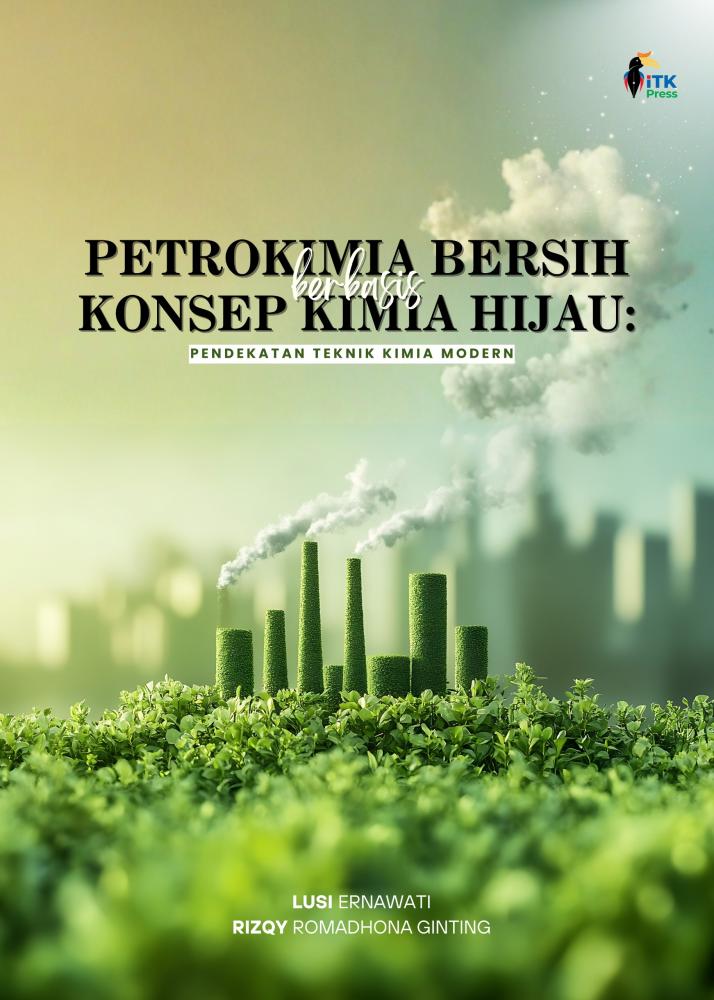
Petrokimia Bersih Berbasis Konsep Kimia Hijau: Pendekatan Teknik Kimia Modern
Keywords:
Efisiensi Energi, Keberlanjutan Industri, Kimia Hijau, Petrokimia Bersih, Rekayasa ProsesSynopsis
Petrokimia Bersih Berbasis Konsep Kimia Hijau: Pendekatan Teknik Kimia Modern menyajikan kajian komprehensif mengenai upaya transformasi industri petrokimia menuju sistem produksi yang berkelanjutan dan berwawasan lingkungan. Buku ini menekankan integrasi prinsip-prinsip kimia hijau dalam rekayasa proses petrokimia, mencakup aspek pemilihan bahan baku, pengembangan katalis, desain dan optimasi reaktor, efisiensi energi, serta strategi pengurangan emisi dan limbah. Dengan pendekatan teknik kimia modern yang menggabungkan landasan teoritis, perkembangan teknologi mutakhir, dan contoh penerapan di industri, buku ini memberikan pemahaman yang utuh mengenai peran teknik kimia dalam menjawab tantangan global terkait keberlanjutan dan transisi energi. Ditujukan bagi mahasiswa tingkat lanjut, dosen, peneliti, serta praktisi industri, buku ini diharapkan menjadi referensi akademik sekaligus bacaan inspiratif dalam pengembangan petrokimia bersih yang inovatif dan berdaya saing.
Order now
References
Abdussalam-Mohammed, W., Ali, A. Q., & Errayes, A. O. (2020). Green chemistry: Principles, applications, and disadvantages. Chemical Methodologies, 4(4), 408–423. https://doi.org/10.33945/SAMI/CHEMM.2020.4.4
ACS Omega. (2021). Green chemistry: A framework for a sustainable future. ACS Omega, 6, 16254–16258. https://doi.org/10.1021/acsomega.1c03011
Adambekova, A., Kozhagulov, S., Quadrado, J. C., Salnikov, V., Polyakova, S., Tazhibayeva, T., & Ulman, A. (2025). Reducing atmospheric pollution as the basis of a regional circular economy: Evidence from Kazakhstan. Sustainability, 17(5), Article 2249. https://doi.org/10.3390/su17052249
Aghel, B., Janati, S., Wongwises, S., & Safdari Shadloo, M. (2022). Review on CO₂ capture by blended amine solutions. International Journal of Greenhouse Gas Control, 117, Article 103715. https://doi.org/10.1016/j.ijggc.2022.103715
Akhtar, M. S., & Zaman, W. (2025). Sustainable catalysis for green chemistry and energy transition. Catalysts, 15(8), 773. https://doi.org/10.3390/catal15080773
Amoneit, M., Weckowska, D., Spahr, S., Wagner, O., Adeli, M., Mai, I., & Haag, R. (2024). Green chemistry and responsible research and innovation: Moving beyond the 12 principles. Journal of Cleaner Production, 484, Article 144011. https://doi.org/10.1016/j.jclepro.2024.144011
Anastas, P., & Eghbali, N. (2010). Green chemistry: Principles and practice. Chemical Society Reviews, 39(1), 301–312. https://doi.org/10.1039/B918763B
Asgharian, H., Lund, H., Zinck Thellufsen, J., Iov, F., Nielsen, M. P., & Liso, V. (2025). Green ammonia production in Denmark: Assessing future potentials and challenges. Fuel, 387, Article 134423. https://doi.org/10.1016/j.fuel.2025.134423
Astuti, L. (2024). Tantangan dan peluang industri petrokimia di Indonesia. Kementerian Perindustrian Republik Indonesia.
Boero, A. J., Kardux, K., Kovaleva, M., Salas, D. A., Mooijer, J., Mashruk, S., Townsend, M., Rouwenhorst, K., Valera-Medina, A., & Ramirez, A. D. (2021). Environmental life cycle assessment of ammonia-based electricity. Energies, 14(20), 6721. https://doi.org/10.3390/en14206721
Bukhari, M., Ncube, A., Fiorentino, G., Passaro, R., & Mtetwa, S. (2023). Circular economy and green chemistry: The need for radical innovative approaches in the design for new products. Energies, 16(4), 1752. https://doi.org/10.3390/en16041752
Ghavam, S., Vahdati, M., Wilson, I. A. G., & Styring, P. (2021). Sustainable ammonia production processes. Frontiers in Energy Research, 9, Article 580808. https://doi.org/10.3389/fenrg.2021.580808
Harasymchuk, I., Kočí, V., & Vitvarová, M. (2024). Chemical recycling: Comprehensive overview of methods and technologies. International Journal of Sustainable Engineering, 17(1), 124–148. https://doi.org/10.1080/19397038.2024.2409162
Jacquemin, L., Pontalier, P. Y., & Sablayrolles, C. (2012). Life cycle assessment (LCA) applied to the process industry: A review. International Journal of Life Cycle Assessment, 17(8), 1028–1041. https://doi.org/10.1007/s11367-012-0432-9
Jiang, J. R., Feng, X., Yang, M., & Wang, Y. (2020). Comparative technoeconomic analysis and life cycle assessment of aromatics production from methanol and naphtha. Journal of Cleaner Production, 277, Article 123525. https://doi.org/10.1016/j.jclepro.2020.123525
Khlaifat, A., Fakher, S., Ezzat, F. H., Alalaween, M., & Galiotos, J. (2025). Integrating circular economy principles in petroleum produced water management: Toward sustainable resource recovery and waste minimization. Processes, 13(11), 3604. https://doi.org/10.3390/pr13113604
Kim, L. S., Yoon, C., Lee, D., Shin, G., & Jung, S. (2024). A study on the sustainability of petrochemical industrial complexes through accident data analysis. Processes, 12(12), 2637. https://doi.org/10.3390/pr12122637
Kiss, A. A., & Olujić, Ž. (2014). A review on process intensification in internally heat-integrated distillation columns. Chemical Engineering and Processing: Process Intensification, 86, 125–144. https://doi.org/10.1016/j.cep.2014.10.017
Kurien, C., & Mittal, M. (2022). Review on the production and utilization of green ammonia as an alternate fuel in dual-fuel compression ignition engines. Energy Conversion and Management, 251, Article 114990. https://doi.org/10.1016/j.enconman.2021.114990
Li, T., Shoinkhorova, T., Gascon, J., & Ruiz-Martínez, J. (2021). Aromatics production via methanol-mediated transformation routes. ACS Catalysis, 11(13), 7780–7819. https://doi.org/10.1021/acscatal.1c01422
Ma, S., Ding, W., Liu, Y., Zhang, Y., & Ren, S. (2024). Industry 4.0 and cleaner production: A comprehensive review of sustainable and intelligent manufacturing for energy-intensive manufacturing industries. Journal of Cleaner Production, 467, Article 142879. https://doi.org/10.1016/j.jclepro.2024.142879
Mayer, P., Ramírez, A., & others. (2023). Blue and green ammonia production: A techno-economic and life cycle assessment perspective. iScience, 26(9), Article 107389. https://doi.org/10.1016/j.isci.2023.107389
Popoola, L. T., Nwogbu, C. C., Taura, U., Asmara, Y. P., Agbo, A. O., Aderibigbe, T. A., et al. (2026). Achieving effective operations in petrochemical industries using affordable and clean energy: Techniques, benefits, barriers and solutions. Cleaner Waste Systems, 13, Article 100453. https://doi.org/10.1016/j.clwas.2025.100453
Pratschner, S., Radosits, F., Ajanovic, A., & Winter, F. (2023). Techno-economic assessment of a power-to-green methanol plant. Journal of CO₂ Utilization, 75, Article 102563. https://doi.org/10.1016/j.jcou.2023.102563
Singh, B. J., Chakraborty, A., & Sehgal, R. (2023). A systematic review of industrial wastewater management: Evaluating challenges and enablers. Journal of Environmental Management, 348, Article 119230. https://doi.org/10.1016/j.jenvman.2023.119230
Wei, L., Wang, H., Dong, Q., Li, Y., & Xiang, H. (2025). A review on the research progress of zeolite catalysts for heavy oil cracking. Catalysts, 15(4), Article 401. https://doi.org/10.3390/catal15040401
Wu, M., Liu, W., Ma, Z., Qin, T., Chen, Z., Zhang, Y., Cao, N., Xie, X., Chi, S., Xu, J., et al. (2024). Global trends in the research and development of petrochemical waste gas from 1981 to 2022. Sustainability, 16(14), 5972. https://doi.org/10.3390/su16145972
Yang, X., Zhang, Y., Sun, P., & Peng, C. (2024). A review on renewable energy: Conversion and utilization of biomass. Smart Molecules, 2(2), Article n.pag. https://doi.org/10.1002/smo.20240019
Yudhistira, B. (2022). Tantangan hilirisasi industri petrokimia Indonesia. Center of Economic and Law Studies (CELIOS).
Zhang, Y., Xing, E., Han, W., Yang, P., Zhang, S., Liu, S., et al. (2024). Petrochemical industry for the future. Engineering, 43, 99–114. https://doi.org/10.1016/j.eng.2024.06.017
Zoghlami, A., & Paës, G. (2019). Lignocellulosic biomass: Understanding recalcitrance and predicting hydrolysis. Frontiers in Chemistry, 7, 874. https://doi.org/10.3389/fchem.2019.00874
Published
License

This work is licensed under a Creative Commons Attribution-NonCommercial-ShareAlike 4.0 International License.